
Private school voucher policies, which have operated in states for decades, allow families to use taxpayer-funded public education money to pay private school tuition. While students with disabilities are entitled to free and appropriate education within public schools through the Individuals with Disabilities Education Act (IDEA), private schools are exempt from the IDEA’s requirements. This means that private school voucher policies channel funds away from public schools that accommodate disabled students to private schools that may not. Last year, the One Big Beautiful Bill Act established a federal tax credit scholarship program that will take effect in January 2027. This will allow individuals to claim a tax credit matching their donation to Scholarship Granting Organizations (SGOs), which will then distribute funds to eligible K-12 students to pay private school tuition. As of May 2026, 30 states have indicated their intent to participate or formally opted into the program. Evaluating similar programs at the state level shows that the federal program may pose a threat to students with disabilities and IDEA compliance in public schools.
Evidence From State Voucher Programs
In addition to not being required to provide special education services, many private schools are exempt from anti-discrimination provisions under the Americans with Disabilities Act because of their religious affiliations. Discrimination towards students with disabilities by private schools is highly apparent, with nearly half explicitly stating their inability to accommodate or enroll disabled students in their publicly available materials. Moreover, state tax credit scholarship programs often provide insufficient funding by failing to cover full tuition expenses or excluding special education expenses as eligible use of funds. In 2024-2025, programs that factor participation for disabled students covered just 36 percent of average private school tuition in their respective states, leaving families to pay an average of $8,845 out of pocket. Unlike some state programs, the federal program offers no additional financial support for students with disabilities, which could replicate these funding gaps.
In order to receive increased reward amounts or qualify for some voucher programs, many states require Individualized Education Program (IEP) documentation for students with disabilities. In Texas, where the state’s Education Freedom Account program allows an additional $20,000 for participating disabled students, public schools have seen a surge in IEP evaluation requests connected to this requirement. Some reports state that families are seeking evaluations despite never suspecting their children of having disabilities so that they may access increased funds. The resulting influx of evaluation requests has reduced districts’ ability to maintain compliance with evaluation timelines for both private and public-school students. Under the federal program, lack of increased reward amounts for students with disabilities may limit their ability to participate, while IEP requirements for increased funds may place strain on special education systems. Until final regulations for the federal program are released, it is unclear whether states will be able to adopt design features that would address these limitations.
The federal program may also accelerate public school enrollment declines as participating students enter private schools. Over the past five years, public schools have lost 1.18 million students, while many private schools report increased enrollment compared to pre-pandemic levels. Combined with discrimination and financial barriers that may prevent disabled students from participating in the federal program, these enrollment shifts could increase the concentration of special education students in public schools. This could contribute to financial strain in public schools, as most states use enrollment-based calculations to determine district funding allocations and calculations for IDEA part B funding do not factor the concentration of disabled students in a district. Financial strain may lead districts to outsource services, which special education services are more vulnerable to due to ongoing staffing shortages within the sector. Outsourcing school services is associated with poor staffing practices including workforce reductions, decreased training, temporary staffing arrangements, and replacement of in-person staff with virtual support. Such changes risk undermining IDEA compliance and the quality of special education services received by students.
While further data collection and research is necessary to confirm the effects of private school voucher programs on outcomes for disabled students, it’s clear that the federal program poses a potential threat to special education systems nationwide. Introduced by Senator Mark Kelly, the Keep Public Funds in Public Schools Act (S.4297) would address this issue by repealing the federal tax credit scholarship program. With 33 independent and Democrat cosponsors, the bill will require bipartisan support to advance. Citizens may urge their Senators to support the bill and ask their Governors to either decline participation in the federal program or express opposition if they have already joined. Doing so can help ensure that both legislative and executive officials consider public concerns before the federal program takes effect in January 2027.
What We Can Do
While further data collection and research is necessary to confirm the effects of private school voucher programs on outcomes for disabled students, it’s clear that the federal program poses a potential threat to special education systems nationwide. Introduced by Senator Mark Kelly, the Keep Public Funds in Public Schools Act (S.4297) would address this issue by repealing the federal tax credit scholarship program. With 33 independent and Democrat cosponsors, the bill will require bipartisan support to advance. Citizens may urge their Senators to support the bill and ask their Governors to either decline participation in the federal program or express opposition if they have already joined. Doing so can help ensure that both legislative and executive officials consider public concerns before the federal program takes effect in January 2027.
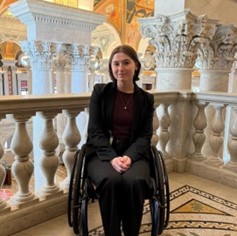
Bio: Lillian Olsen, Co-founder and former president of University of Vermont Disabled Student Union, Spring 2026 Disability Policy Intern with the U.S. Senate Committee on Health, Education, Labor & Pensions.
ID: Lillian is a white, woman-presenting person with shoulder length brown hair, wearing a black pants and a blazer over a maroon shirt. They are sitting in a wheelchair on a mezzanine at the Library of Congress with columns and painted ceilings in the background. https://www.linkedin.com/in/lillian-olsen-17b185294/

