
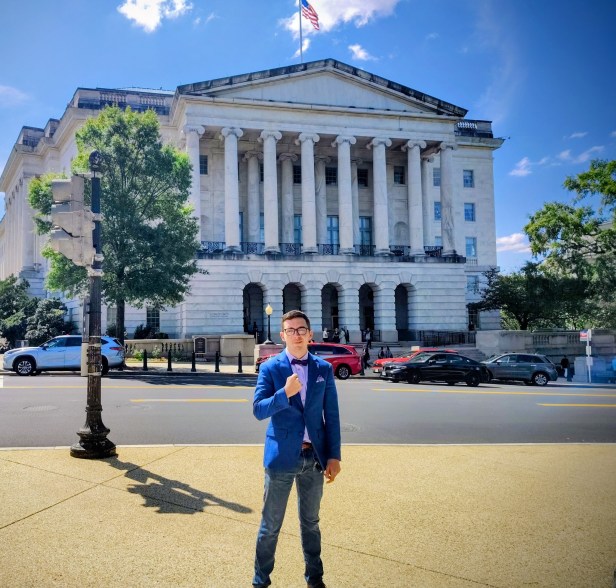
On September 9th, 2025, I was invited to testify on Capitol Hill before the Joint Social Security and Work & Welfare Subcommittee to share my employment journey and inform policy focused on how services and supports can support competitive, integrated employment for people with disabilities. I am sharing an adapted version of that testimony in this blog:
My name is Sean Tyree, and I am a research aide and self-advocate at the University of Kansas Center on Disabilities (KUCD). Authorized under the Developmental Disabilities Act, KUCD is the University Center for Excellence in Developmental Disabilities, also known as a UCEDD, in the state of Kansas.
I am testifying today regarding my journey through several government programs and service systems, including Supplemental Security Income (SSI) and Social Security Disability Insurance (SSDI), that have supported me to become competitively employed in the state of Kansas. I am a person with a disability. I have a neuromuscular condition called Charcot-Marie-Tooth or CMT type 1A that was inherited at birth through my father. CMT is a degenerative disease, meaning it does NOT ever get better; it only gets worse.
High school was a challenging time. I had multiple leg surgeries and rehabilitation and faced a lot of bullying. But I had a 504 plan, which ensured that I got the accommodations I needed to be successful in school. Section 504 is part of the federal Rehabilitation Act. I also received Vocational Rehabilitation (VR) services from ages 14 to 21. VR services supported me in learning about jobs, and through VR, I received tuition and assistance to attend community college online after high school. When I turned 18, my mom also helped me get on the Medicaid Home and Community Based Services waitlist for people with physical disabilities. In the state of Kansas, this waitlist was around 2 years.
I wanted to be a teacher, and I graduated with an Associates of Arts degree in August of 2023. I worked as a substitute teacher for three years. VR supported me to be successful in this position, including purchasing work clothes and the required technology But, after a few years in the classroom, I decided to make a career change. I started volunteering to learn more about career opportunities. I volunteered for the My Transition My Career Topeka Community Team, an initiative led by KUCD. These Community Teams bring together youth with disabilities, families, schools, and service providers to support youth with disabilities to get jobs in the community.
Through this work, I learned about a research aide job at KUCD. I thought my strong voice as a self-advocate and my lived experience with a disability could be useful to the work that KU was doing to enhance competitive, integrated employment for people with disabilities. I applied and got the job. As a research aide, I work to advance employment and transition supports for other people with disabilities and I earn competitive wages and benefits. I used benefit planning services to make this work when I took the job at KUCD.
As a working adult, I receive Medicaid and Medicare benefits and personal care services – all essential to my health and success. A benefits counselor supported me to learn how my benefits would be impacted if I worked beyond the trial work period limits, and to plan for working while maintaining needed services. These federal and state programs are essential to my competitive, integrated employment.
The $2,000 asset limit for qualifying for services from the Home and Community Based Service Waiver is a huge barrier to people with disabilities like me in seeking employment. I opened an ABLE savings account, which allows me to save up to $19,000 per year for “Qualified Disability Expenses.” This lets me save for things like a car to get to work and other supportive technology that is not typically covered by Medicaid or Medicare. With my ABLE savings, I have a little nest egg for emergencies. People with disabilities deserve to be able to maintain benefits that support their health and independence and have a job.
Largely because of the services I receive and the support of my family, mentors, and friends, I believe my long-term potential to live the life I want is far better with a meaningful job in the community.
I love my job at KUCD and believe that as people with disabilities work, they should have the benefits and supports to empower them. Since being employed, I have had fewer hospital visits and now have a real purpose in my life to help others with disabilities reach their goals.
I have developed as a professional and have built enough confidence to testify in front of Congress about my lived experiences. I would not be sitting before you today without the federal and state level supports and services I have received such as Medicaid, Medicare, SSDI, ABLE, Section 504, and VR. I have a higher quality of life because of my work and these services.
People with disabilities can achieve far more than society often expects; like everyone else, they simply need the right supports to learn, grow, and pursue their purpose in life. Thanks to the opportunities provided by KUCD, I discovered a career I love. Without federal programs that promote competitive, integrated employment while ensuring access to essential Medicaid benefits, many people like me might face institutionalization or lose the supports needed to thrive and grow professionally in a career they are passionate about.
 AUCD Policy Talk